What is Spousal Support?
Spousal support is money that is paid by one person to his or her spouse after separation, either monthly or in one lump sum.
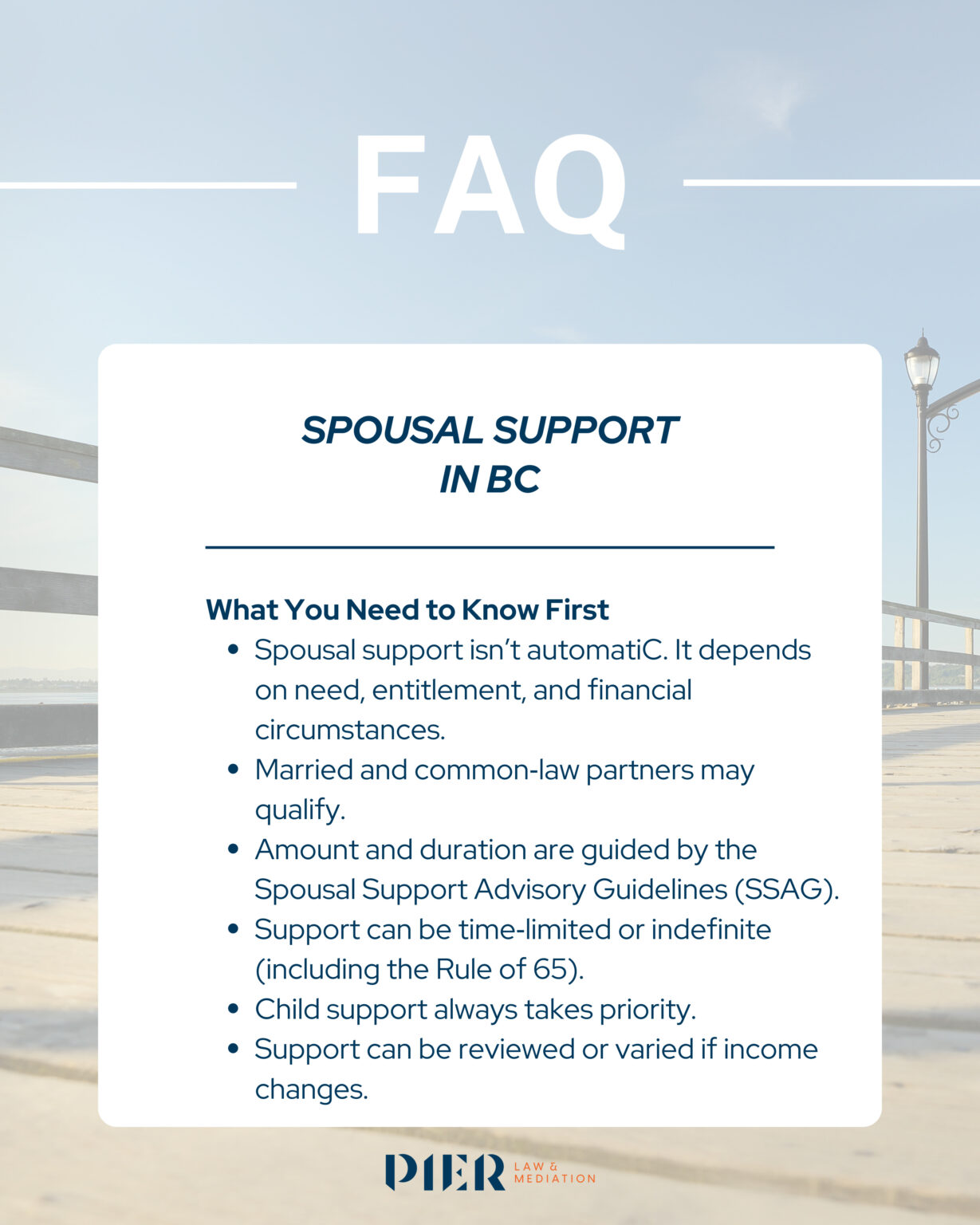
Spousal support can be ordered (or agreed upon) under the Family Law Act or the Divorce Act. Regardless of under which Act a claim for spousal support is made, figuring out spousal support is subject to a two-step process.
An application for spousal support must prove two things:
- Entitlement
- Quantum (amount)
Step 1: Entitlement of Spousal Support
The first step in the process is to find one’s entitlement to spousal support. There are three ways a person can be entitled to spousal support after the dissolution of a relationship:
- Two spouses entered into a contractual agreement at some point, before, during, or after their relationship ended, which requires one spouse to pay the other spousal support.
- One spouse has need and the other is able to pay.
- One spouse deserves some compensation for the his or her role, responsibilities, and/or sacrifices he or she made during the relationship.
It is important to keep in mind, the legislative goals of spousal support.
Section 161 of the Family Law Act outlines four objectives which are:
- To recognize any economic advantages or disadvantages to the spouse arising from the relationship between the spouses or the breakdown of that relationship;.
- To apportion between the spouses any financial consequences arising from the care of their child, beyond the duty to provide support for the child;.
- To relieve any economic hardship of the spouses arising from the breakdown of the relationship between the spouses, and;
- As far as practicable, to promote the economic self-sufficiency of each spouse within a reasonable period of time.
The Divorce Act also sets out the objectives of spousal support orders at section 15.2(6). It is important to note that the goals as set out in both the Family Law Act and the Divorce Act are almost identical. Some examples of situations where there is entitlement to spousal support include:
- A spouse prioritized the other spouse’s career over their own to advance the goals or needs of the family.
- A spouse left the paid work force to focus their time more on meeting the needs of the household and/or family.
- A spouse is dependent on the other financially to meet their financial needs.
- A spouse as become accustomed to a lifestyle provided by their spouse which they are unable to achieve financially on their own.
- A spouse sacrificed in some way to support their spouse in the advancement of their studies or career training.
Regardless of any differences in income between spouses, if there is no basis for entitlement to spousal support, there is no spousal support!
But, if entitlement is confirmed, then we move on to the next step in the process: figuring out quantum.
Step 2: Quantum (Spousal Support Amount)
If a spouse is found to be entitled to spousal support, we move to the second part of the process. This second step involves figuring out how much the spousal support amounts should be, if anything, and for how long.
This is where the Spousal Support Advisory Guidelines come into play.
Spousal Support Advisory Guidelines
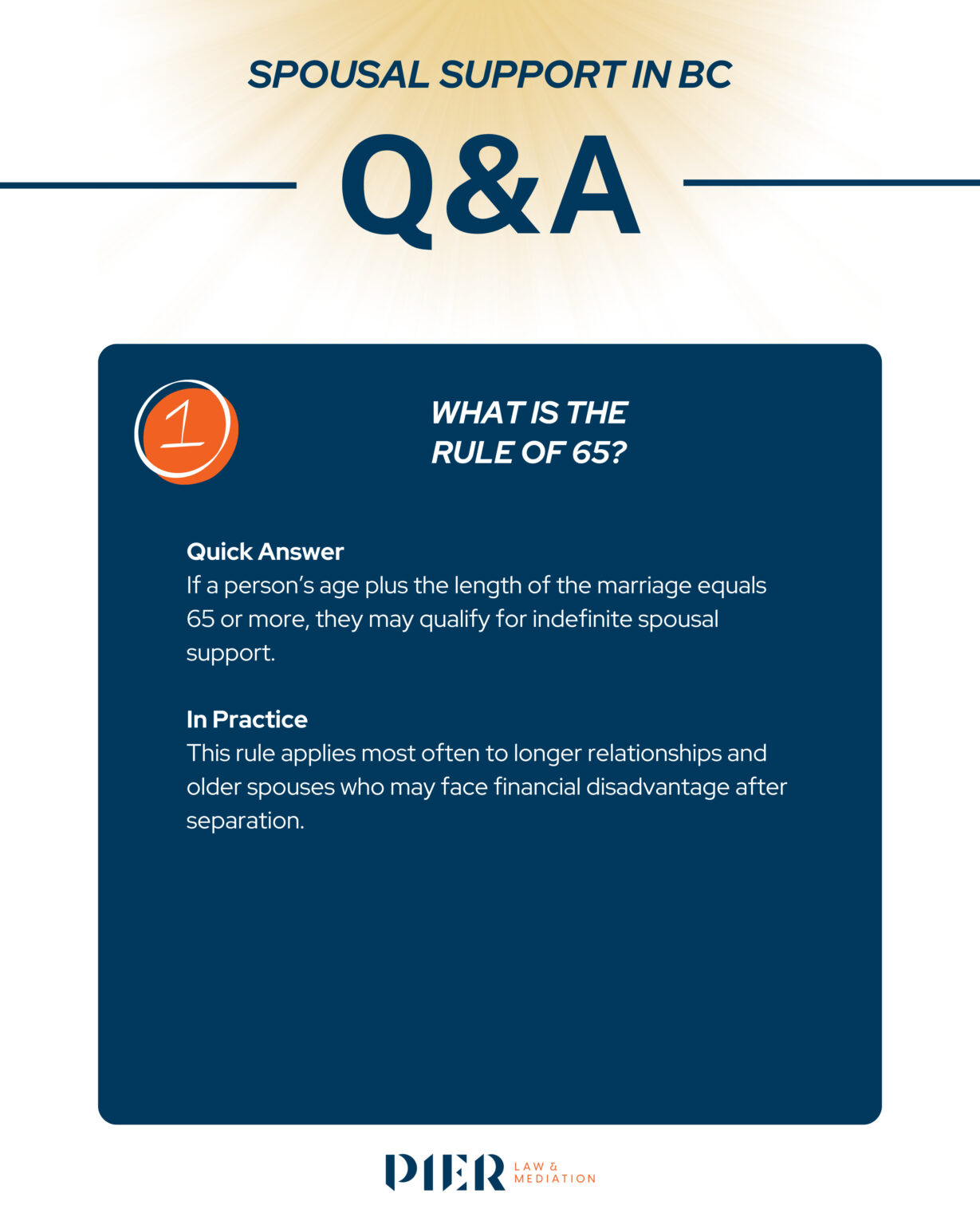
Typically, In BC, we look to the Spousal Support Advisory Guidelines to figure out how much the spousal support payment should be, and for how long the payment should go on for. The Spousal Support Advisory Guidelines are not law, but they supply provide a guideline and some direction for the courts to decide how much spousal support is right in each circumstance.
The Spousal Support Advisory Guidelines are used across the country, and as noted, are advisory only in nature. Nevertheless, in BC, the Court of Appeal has been clear in its direction that the Spousal Support Advisory Guidelinesmust be given significant weight in deciding spousal support.
In fact, if a judge makes an order different from the values given by the Support Advisory Guidelines without a good reason, the judge’s order could be appealed. What this means is that the spousal support order could be overturned by another judge.
Basically, the Spousal Support Advisory Guidelines are an attempt to put into a mathematical formula how the majority of spousal support cases have and are being decided in Canada.
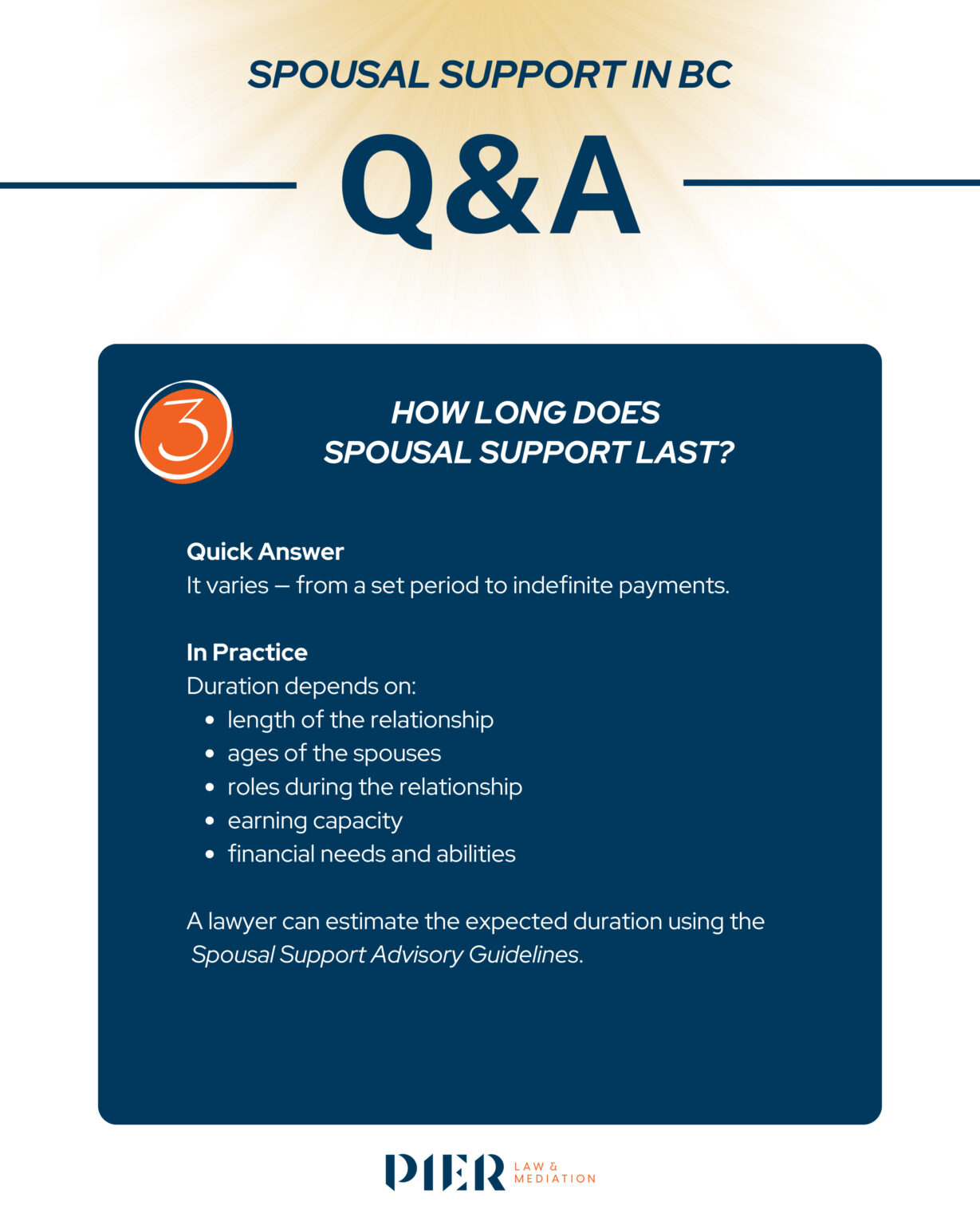
The Spousal Support Advisory Guidelines look at factors such as:
- Length of time the spouses lives together
- Income of the spouses
- Ages of the spouses
- Number of children, if any (and ages of the children)
- Special and Extraordinary Expenses of the children

Calculating Spousal Support
Specialized software has been developed to conduct these mathematical calculations for spouses called: DivorceMate. Once the data is entered into DivorceMate, the system will result in calculate a range of monthly spousal support calculations specific to your situation. There are two separate formulas used:
- The “With Child” Formula
- The “With-Out Child” Formula
The DivorceMate calculation will give you a low-range, mid-range, and high-range value. It will also give you a range for how many years the payments should be made.
DivorceMate does have a free online tool on the internet: My Support Calculator. However, this free version is limited in its functionality and does note consider many factors used in the paid version.
If you are entitled to receive or must pay spousal support, you should have a lawyer run calculation on the full and paid version of the software, DivorceMate, before making any final commitments on this issue.
Spousal Support Time Limitations
These time limits are called ‘limitation periods’. Once a limitation period expires, a spouse can no longer apply for spousal support. If you and your spouse are or were married, you can apply for spousal support under the Divorce Act. There are no limitation periods for spousal support under the Divorce Act. Nevertheless, you are best to make your claim for support sooner rather than later, if you can.
Under the Family Law Act, limitation periods do apply.
- If you were married, you must apply for spousal support within 2 years of your divorce.
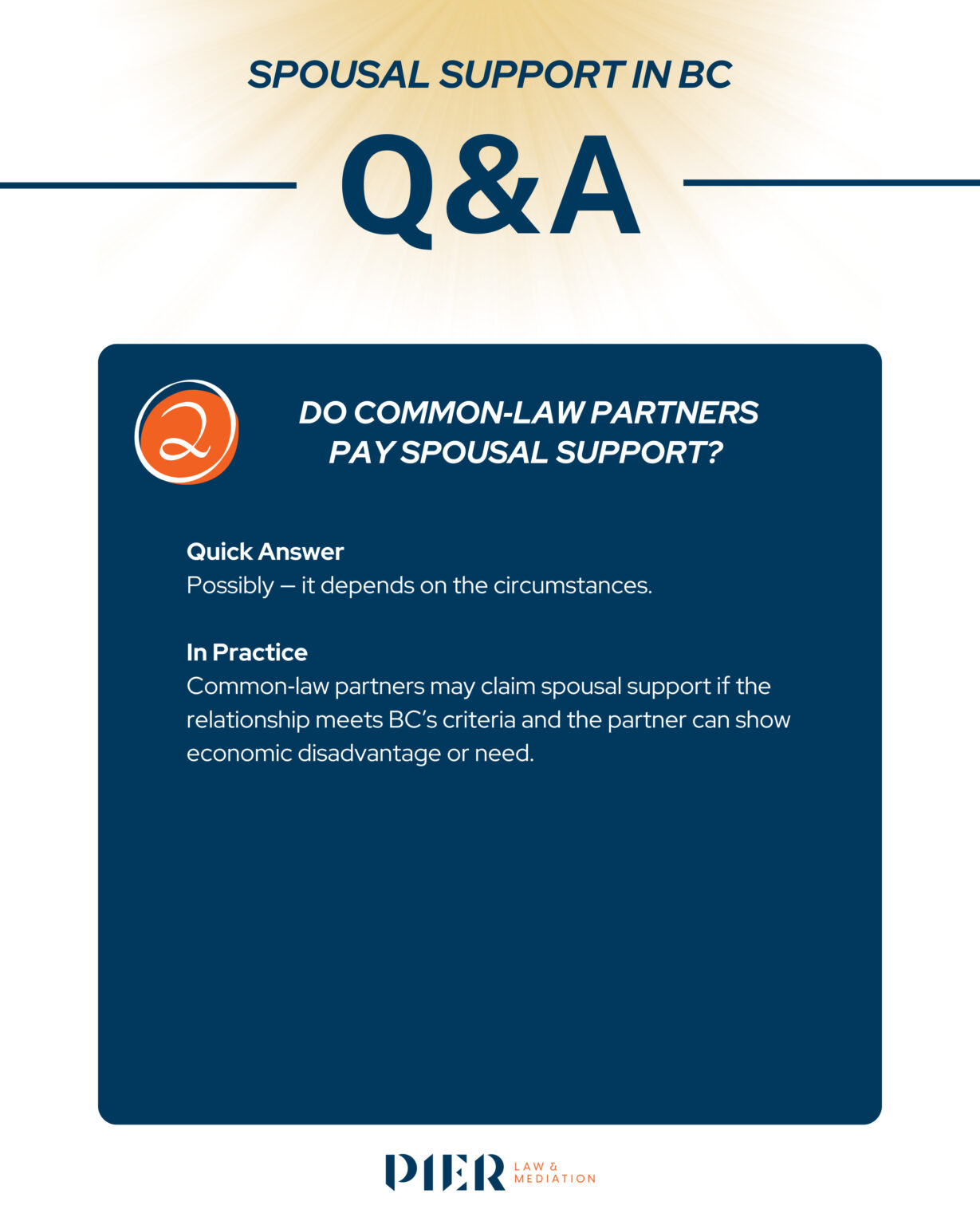
- If you are not married, but still qualify as a spouse under the definition set out in the family Law Act, you must apply for spousal support within 2 years of your separation date.
- Calculating spousal support can be challenging and it is important to meet the spousal support limitation periods. At Pier Law & Mediation, we are here to help you navigate spousal support law.
Call Pier Law & Mediation to help you resolve your family law matter. We can be reached at 604-560-8285 or via email at info@pierfamilylawyers.com.

Spousal Support FAQ