
Part 2 Planning for Stability: Support Options for BC Families in Transition—Child Support and Spousal Support
Once complete financial disclosure is exchanged (hyperlink back to part 1 article), families can begin addressing one of the most important parts of separation planning: support obligations.
In British Columbia, child support and spousal support are governed by legislation and guidelines designed to promote fairness, stability, and predictability, while still allowing flexibility for individual circumstances.
This article provides an overview of how support is determined in BC, and what families should understand before reaching an agreement.
Note: This article provides general legal information only and is not legal advice. Family law outcomes depend on individual circumstances.
The Purpose of Support
Support is not about punishment or reward. Its objectives include:
- Ensuring children’s needs are met.
- Reducing economic hardship after separation.
- Recognizing caregiving and economic contributions.
- Promoting long‑term financial stability where possible.
Child Support in British Columbia: The Legal Duty to Support Children
Under section 147 of the Family Law Act, parents and guardians have a legal duty to support their children financially, with limited exceptions.
Child support is considered the right of the child, not the parent.
How Much Child Support Is Payable?
Child support in BC is determined using:
- The Federal Child Support Guidelines.
- Each parent’s guideline income.
- The parenting arrangement.
In most cases, child support is determined by mandatory tables that provide predictable amounts based on income and number of children.
Child Support Calculation Checklist (BC)
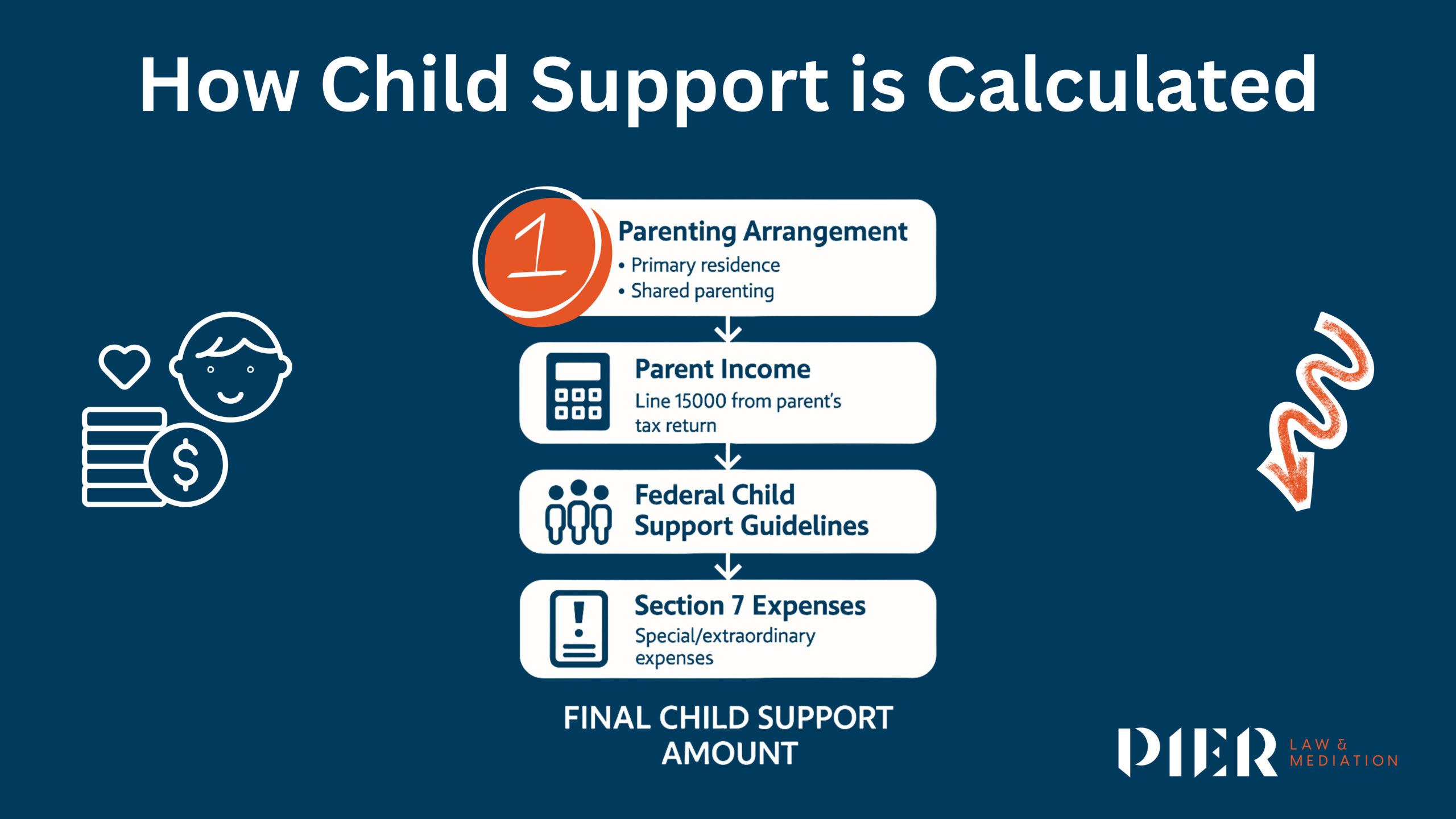
Step 1: Determine the Parenting Arrangement
- Primary residence: one parent has the child more than 60% of the time.
- Shared parenting: each parent has the child at least 40% of the time.
- Split parenting: multiple children live primarily with different parents.
Step 2: Determine Each Parent’s Income
- Start with Line 15000 of the most recent tax return
- Adjustments may be required for:
- Self‑employment.
- Irregular or fluctuating income.
- Under‑ or over‑reported income.
Step 3: Apply the Federal Child Support Guidelines
The table amount depends on:
- Paying parent’s income.
- Number of children.
- Province (British Columbia).
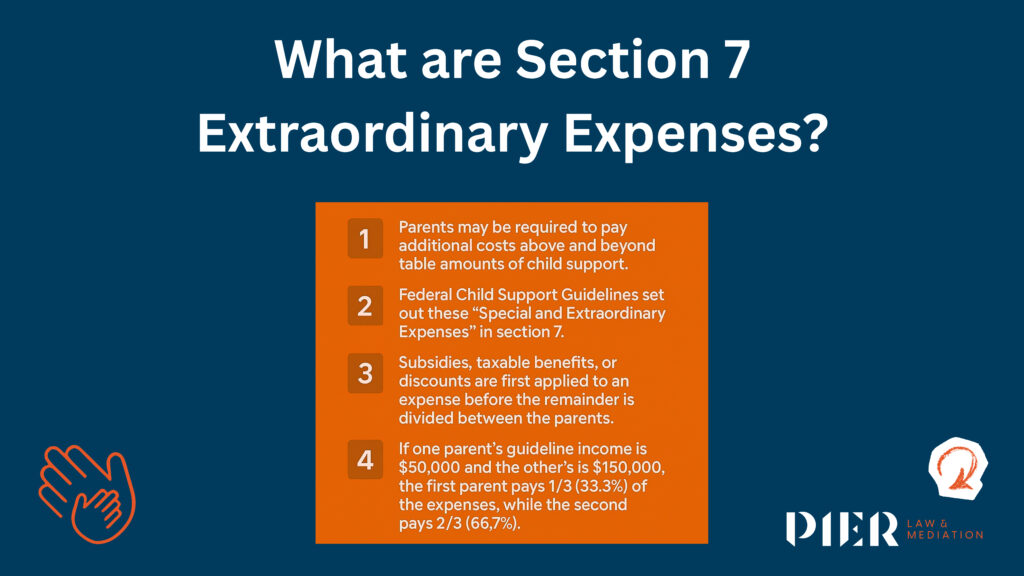
Step 4: Add Section 7 (Special and Extraordinary Expenses)
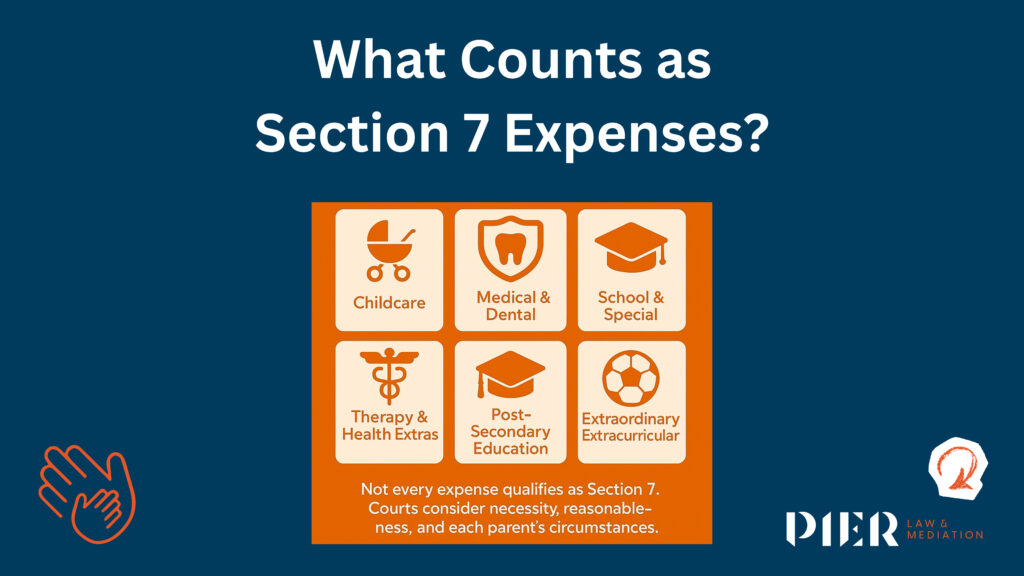
In addition to base child support, parents may share special or extraordinary expenses, including:
- Childcare.
- Medical and dental costs not covered by insurance.
- Post‑secondary education.
- Extraordinary extracurricular activities.
These expenses are:
- Shared in proportion to income, not equally.
- Calculated after applying any subsidies or benefits.
Example: If one parent earns $50,000 and the other earns $150,000, the costs are shared by the parents: 33% / 67%.
Step 5: Review and Adjust
- Shared parenting offsets may apply.
- Undue hardship claims are possible but uncommon.
- Annual income updates are strongly recommended.
Spousal Support in British Columbia: What Is Spousal Support?
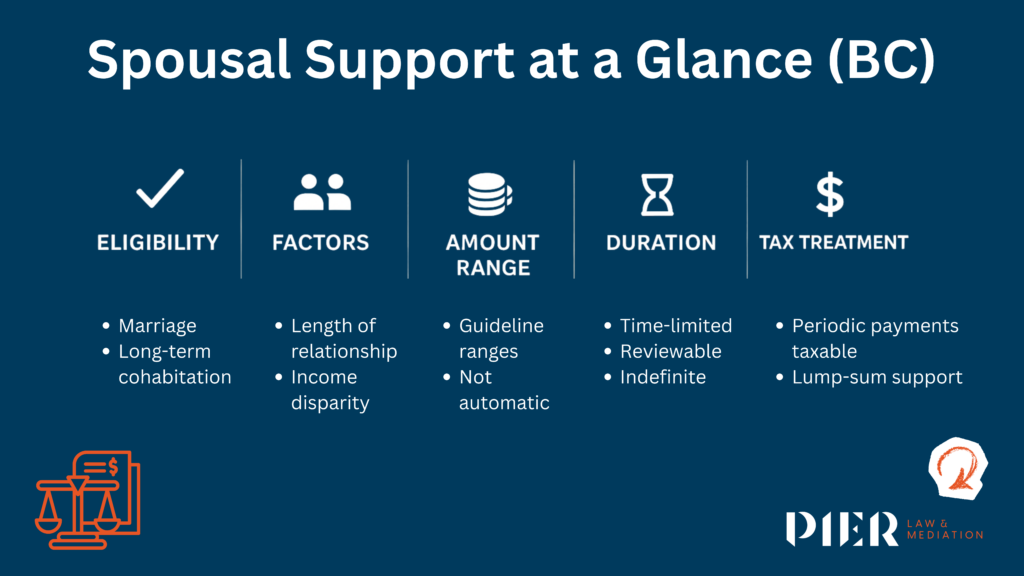
Spousal support is financial assistance paid by one spouse to the other after separation, either periodically or as a lump sum. Claims may arise under the Family Law Act or the Divorce Act.
Step 1: Entitlement to Spousal Support
Entitlement must be established before discussing amounts or duration. A spouse may be entitled where:
- There is financial need and the other spouse has the ability to pay.
- The spouse suffered economic disadvantages due to the relationship.
- The spouse made career-or-caregiving-sacrifices.
- The parties agreed to support by contract.
If there is no entitlement, there is no spousal support, even if income differs.
Legislative Objectives of Spousal Support
Section 161 of the Family Law Act sets out key goals:
- Recognizing economic advantages or disadvantages.
- Apportioning financial consequences of childcare.
- Relieving economic hardship after separation.
- Promoting self‑sufficiency where practicable.
The Divorce Act contains nearly identical objectives.
Step 2: Quantum (Amount and Duration)
Once entitlement is established, courts and practitioners look to the Spousal Support Advisory Guidelines (SSAGs).
Important to Know:
- The SSAGs are not law, but they carry significant weight.
- Courts are expected to follow them unless a clear reason exists.
- They provide ranges, not fixed outcomes.
Factors considered include:
- Length of the relationship.
- Income of both of the spouses.
- Ages and health.
- Number and ages of children.
- Child Support and Section 7 expenses.
Duration of Spousal Support
Support may be:
- Time‑limited.
- Reviewable.
- Indefinite (more common in long‑term relationships).
Tax Considerations
- Periodic spousal support:
- Tax‑deductible for the payor.
- Taxable to the recipient.
- Lump‑sum support:
- Typically, non‑taxable.
Tax implications should always be considered before finalizing an agreement.
Final Thoughts: Planning for Stability
Support arrangements work best when they are:
- Based on accurate financial disclosure.
- Informed by the applicable guidelines.
- Flexible enough to adapt over time.
Professional advice can help families avoid costly mistakes and focus on long‑term stability, especially where children are concerned.
If you would like help navigating child or spousal support in British Columbia, Pier Law & Mediation can assist with legal advice, negotiation, and resolution options. Call 604‑560‑8285, email info@pierfamilylawyers.com, www.pierfamilylawyers.com for more information.

